The Dorsal Fin

Archive for July, 2009

Shark articles appear from…err, Popular Mechanics?

by TheDorsalFin on Jul.31, 2009, under Shark News Stories

I’ll admit that Popular Mechanics isn’t really a media outlet where I would expect to find an objective piece about sharks, but today, two shark-related articles showed up on their website.

Marine Biologist Debunks Common Misconceptions About Sharks is a Q&A session between Popular Mechanics reporter, Erin McCarthy, and Andy Dehart of the National Aquarium. The session deals with misplaced fears, misconceptions about shark diets, and, of course, the declining numbers of sharks worldwide. One encouraging note is that Dehart says, “that the general public is more and more educated about sharks and shark issues.”

The second article, Survive Anything: How to Escape a Shark Attack, discusses how to avoid and escape a shark attack, as unlikely as one may be. The article does mention that there “are approximately 40 shark attacks” in the waters surrounding the U.S. each year. However, I wish it would have mentioned that percentage of those that are serious or fatal. Even though 40 attacks a year, for the entire U.S. coastal areas is still a relatively minuscule number, I think there are people who see the words “shark attack” and automatically assume a fatal attack. The article does go on to mention that you’re more likely to be struck by lightning than to be involved in a shark attack, though. As for the survival tactics, which are offered by George Buress, Director of the Florida Program for Shark Research, they can be broken down into three simple rules…

  1. Be aware of and recognize the signs of aggressive shark behavior. (The article lists hunched back, lowered pectoral fins, erratic swimming, and yawning but fails to mention that these behaviors are not universal to all sharks.)
  2. If you see a shark displaying signs of aggression leave the area “quickly but smoothly” while maintaining visual contact with the shark.
  3. In the rare event that an attack does occur, fight back. (The article mentions the “classic” nose punch as a good defense to buy time to get out of the water.)

All-in-all, the Popular Mechanics articles remain fairly objective and offer up some worthwhile general information to the reader.

Leave a Comment :, , , , , more...

Time Magazine article on sharks and media frenzy

by TheDorsalFin on Jul.30, 2009, under Opinions in the media

Time.com has an article up (interestingly it’s currently dated at August 10, 2009, which I’m guessing is the date it will appear in print) titled, Threats with Teeth. The article, written by James Poniewozik, discusses how the media focuses on media overkill and uses the media (over-)reaction to “minor shark attacks” in the summer of 2001, which the media dubbed “Summer of the Shark” as an example.

Poniewozik likens “living every week like it’s Shark Week” to dealing with our current media environment…

To live every week like it’s Shark Week, then, might be a metaphor for living in our media environment: to spend every week titillated by unlikely threats, getting whipped into frenzies, yawning over high-minded stuff like health-care policy and supping from the delicious chum bucket of hysteria.

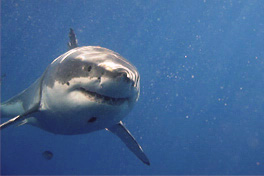
A completely non-threatening white shark

Seriously, now, does this look threatening?

I think Poniewozik is pretty well on-point with the article, and I agree that it seems like society seems more concerned with sensational-yet-unlikely threats than the more boring-yet-likely ones. The news media is a big money-making industry, and at the end of the day, fear of the unknown and unlikely sells. Threats like automobile accidents on the way to the beach, drowning, over-exposure to the sun, bee stings, and jellyfish stings are far more likely to result in the death of a beachgoer than a shark attack, but those other threats are all so passe, in the eyes of the media, compared to the thought of a shark biting someone. As Poniewozik sums it up in the closing paragraph of the article…

…that one-in-a-million chance of being done in by a primeval predator from the murky depths–that’s the threat with teeth.

Leave a Comment :, , , , , , , , more...

Exploiting great white sharks to draw attention to a news article

by TheDorsalFin on Jul.29, 2009, under Shark Misrepresentation, Shark News Stories

Despite having “great white sharks” in the title and a photo of a breaching white shark as a lead-in, the Telegraph article, Sunbeds now seem to be as deadly as great white sharks , has little to nothing to do with great white sharks, at all. It merely serves as a reminder that there are people in the media who will use sharks to grab the attention of a potential audience. (Yes, the article even suckered me in with the title.)

What do white sharks have to do with sunbeds? Nothing at all.

What do white sharks have to do with sunbeds? Nothing at all.

The only mention of great white sharks in the article occurs when author, Bryony Gordon, states, “This week, the World Health Organisation warned that sunbeds are as dangerous as cigarettes and asbestos, which is to say very, very dangerous, almost as dangerous as the great white shark, or lying down in front of a steamroller.”

Actually, Mr. Gordon, statistically-speaking, great white sharks are far less dangerous than cigarettes or asbestos. If you were to compare the number of cancer-related deaths attributed to sunbed use, cigarette use, or asbestos exposure to the number of human deaths caused by white sharks, I think you would find the number of deaths caused by white sharks to be negligible in comparison. The U.S. CDC reports the annual number of deaths due to cigarette use at 440,000 a year, in the U.S. alone. Annual asbestos-related deaths in the U.S. were estimated at over 14,000 in 2002 and are expected to continue to rise. In contrast, the annual number of deaths GLOBALLY, due to white shark attacks, is routinely in the single digits. So, Mr. Gordon, cigarettes and asbestos are not “almost as dangerous as the great white shark.” They are far more dangerous.

I wasn’t able to find any stats on lying down in front of a steamroller, so I apologize to the steamrollers of the world, if you’re being unjustly associated with cigarettes, asbestos, and sunbeds.

Leave a Comment :, , , , more...

Anti-finning “performance display” at Lush cosmetic stores

by TheDorsalFin on Jul.29, 2009, under Shark News Stories

Real Business’ Lush hooks customers with gruesome window display reports about an anti-finning window display appearing at Lush cosmetics stores. According to the article, a former Lush employee and performance artist, Alice Newstead, has been painting herself silver and hanging herself from the ceiling in “a dramatic illustration of shark finning.” The display is part of a campaign between Lush and Sea Shepherd to end overfishing.

Newstead first appeared in the display in London last year…

The display appeared in Paris earlier this month, and the next stop is New York City.

A woman being suspended by hooks from the ceiling of a cosmetics store is certainly a “unique” way to promote shark conservation, to say the least, but it does seem like the display is grabbing the attention of people. Hopefully, that attention will, in turn, lead to an increased awareness about the rapidly declining number of sharks, due to finning and over-fishing.

Leave a Comment :, , , , , , , , more...

New York Times editorial on declining shark numbers

by TheDorsalFin on Jul.29, 2009, under Opinions in the media, Shark News Stories

An editorial, The Death of Sharks, which appeared in print on July 29, 2009, on page A22 of the New York edition, focuses on the declining number of sharks due to finning and overfishing.

The editorial addresses the negative impacts of removing sharks as apex-predators from the marine eco-system:

“The species whose numbers the sharks once controlled begin to explode; they then wipe out smaller fish, some of which humans depend on for food. Water quality suffers. Healthy oceans require sharks, and without healthy oceans, healthy fisheries are impossible.”

Seeing editorials like this one appear in major U.S. media sources is encouraging, as it helps to promote awareness of the threat of extinction of many of the oceans sharks species. Hopefully, we will continue to see media coverage that focuses on shark conservation, as opposed to over-sensationalizing shark-related stories.

Leave a Comment :, , , , , , , , , , more...

Archived Posts

WordPress
-->